Factors That Impact Customer Retention in Shopify Stores
Before adding anything, understand what is pushing customers away. Most retention leaks are operational rather than strategic.
- Slow pages on a mid-range phone. Speed is a retention factor, not just an acquisition one. A returning customer who waits once may not return twice.
- Navigation that assumes familiarity. Repeat buyers want the thing they bought last time in two taps, not a tour of the catalogue.
- Checkout friction. Hidden costs, forced account creation, and too many steps cost you the order and the relationship.
- Unclear returns. A returns policy that is hard to find is read as a policy designed to be hard to use.
- Slow or generic support. The response time on a problem order predicts whether there is a next order.
- No personalisation. A store that treats a twentieth-order customer like a first-time visitor is asking to be replaced.
Several of these are storefront problems rather than app problems, and fixing them is what a Shopify CRO programme does. Adding a retention app on top of a slow checkout buys you a more expensive version of the same result.
When a Custom App Beats Another Off-the-Shelf App
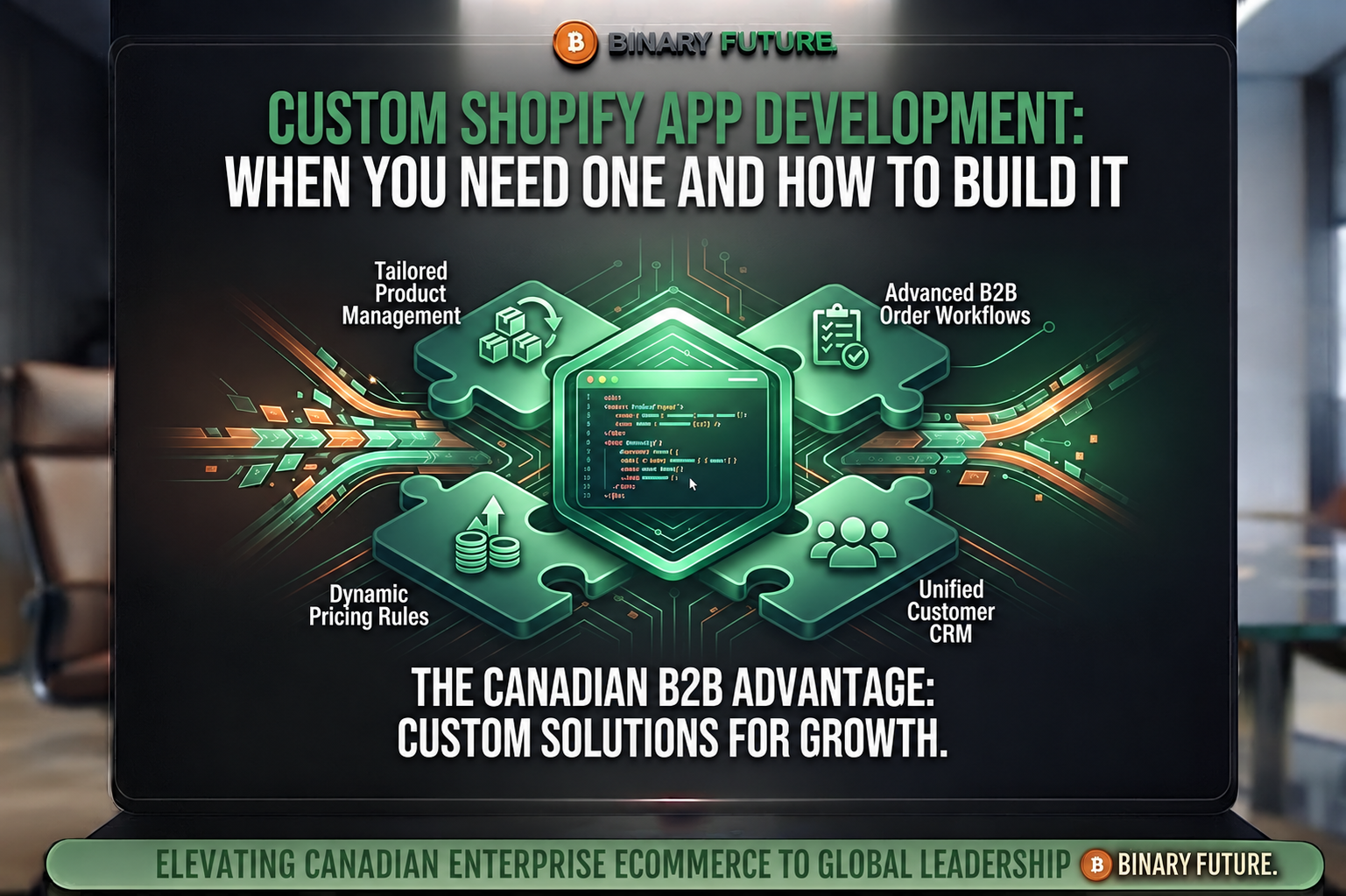
The honest default is off-the-shelf. Loyalty, reviews, subscriptions, and email are solved problems with mature apps, and building your own version of a solved problem is how budgets disappear. The case for custom starts when the stack itself becomes the cost.
- Three or more apps touching the same data. A loyalty app, a subscription app, and an email app each holding their own idea of who the customer is. Support then spends its week reconciling them.
- Logic no app expresses. Rewards that depend on ERP-held purchase history, tiering by contract, or a returns flow specific to your category.
- Subscription cost that scales with revenue. Several apps priced as a percentage of what you sell means your retention tooling gets more expensive precisely as it succeeds.
- Data you cannot get out. When the customer behaviour that drives your decisions lives in a vendor’s database rather than yours.
Two changes in June 2026 moved this line. Shopify introduced Static Apps, which run without a server you have to host and maintain, and made its AI Toolkit generally available for Cursor, Claude Code, Codex, and VS Code (Shopify, June 17, 2026). The recurring cost of owning a small custom app is lower than it was a year ago, which shifts the threshold rather than removing it. Working out where your store sits is the first conversation in custom Shopify app development.
Proven Customer Retention Strategies with Shopify Apps
Whether you build or buy, the mechanisms that work are the same and the order matters.
- Make reordering trivial. Saved carts, one-tap reorder, and order history that is actually browsable. This is the highest-return retention feature and the least exciting.
- Notify against saved intent. Restock and price-drop alerts on wishlisted items convert because the customer already told you what they want.
- Reward what you want repeated. Points for reviews and referrals if you need social proof, points for order frequency if you need volume. A generic points programme rewards nothing in particular.
- Use subscriptions where the product is consumed. Refills, consumables, and pet food. Subscriptions on considered one-off purchases produce cancellations, not retention.
- Close the feedback loop visibly. Collect reviews and photo or video content, then show customers that a change came from their feedback.
Retention partners including Klaviyo, Loop, Smile, Judge.me, and Yotpo now run as Sidekick App Extensions inside the Shopify admin, which is worth knowing before deciding that a custom build is the only route to an integrated experience. Where the customer record genuinely lives in a CRM rather than in Shopify, Shopify CRM and ERP integrations is the project, not an app.
Measuring and Optimizing Retention Success
A retention programme without measurement is a subscription you forgot to cancel. Four numbers are enough.
- Repeat purchase rate. The share of customers who ordered more than once in a rolling twelve months. This is the headline number.
- Time between orders. Shortening it is often easier than increasing the number of buyers who return at all.
- Customer lifetime value by cohort. Compare customers acquired before and after a change rather than looking at a single average.
- Contribution after discounts. A loyalty programme that raises revenue and lowers margin has not worked. Measure after the reward cost, not before.
Benchmark against your own baseline rather than an industry average. Published ecommerce retention benchmarks mix categories with completely different purchase cycles, so they tell you very little about a specific store.
Real Shopify Case Studies & Examples
Rather than repeat vendor case studies with numbers nobody can verify, here are the patterns that recur in scoping conversations.
- The stack that outgrew itself. A store runs five retention apps, each solving something real, and the combined subscription plus the staff time spent reconciling them exceeds what one purpose-built app would cost to own.
- The loyalty programme nobody uses. Points accumulate, the balance is buried three taps deep, and redemption never happens. The programme costs money and changes no behaviour.
- The subscription that was really a discount. Customers subscribe for the introductory price and cancel after the first delivery. Retention on paper, churn in practice.
- The reorder button that fixed it. The least sophisticated intervention on the list, and often the one that moves repeat purchase rate first.
Future of Customer Retention with a Custom Shopify App
Two directions are worth planning for. First, more of the retention surface is moving into the Shopify admin itself, so building a parallel version of something Shopify is about to ship natively is a real risk. Second, discovery is moving to AI assistants, and product data completeness now affects whether a returning customer finds you through an assistant at all. Both point the same way: build what is specific to your business and let the platform handle the general case. What that means for your storefront specifically is covered in effective Shopify customization.
Conclusion
Retention comes from making the second order easy, rewarding what you actually want repeated, and measuring one number honestly. A custom app is the right answer when your stack has started costing more than it returns, not because custom sounds better. If the question is whether a mobile app belongs in that plan at all, the case for and against a Shopify mobile app starts further upstream, and how the data stays in sync covers what happens once it exists.