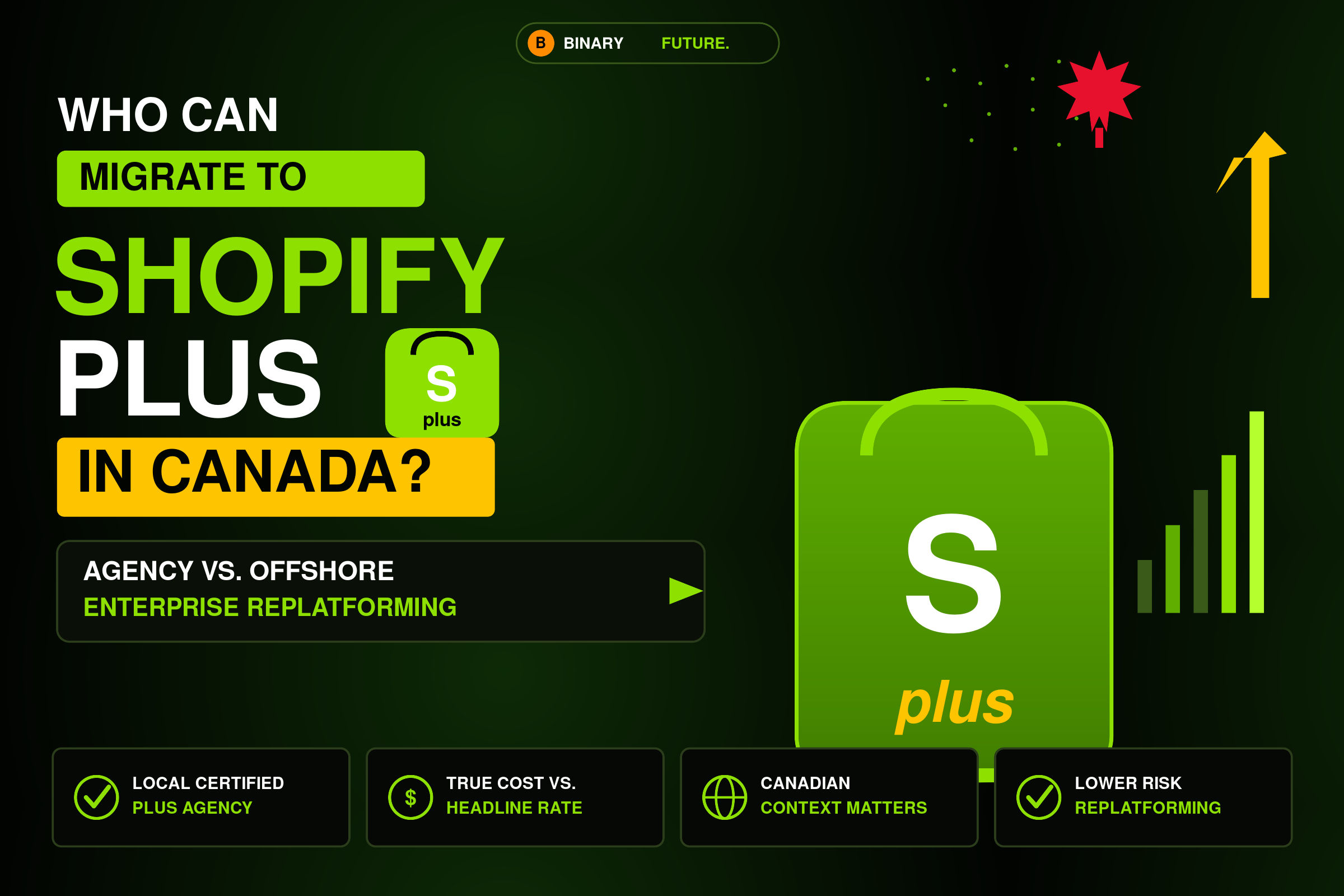
When you ask who can migrate your store to Shopify Plus in Canada, the real choice is usually between a local certified Plus agency and a lower-cost offshore contractor. The headline rate makes offshore look cheaper, but for enterprise replatforming the total cost, in risk, rework, and missing Canadian context, often runs the other way. Here is how to compare them honestly.
For an enterprise Shopify Plus migration in Canada, the choice is a local certified Plus agency versus an offshore contractor. Offshore wins on hourly rate; a local agency wins on the things that decide enterprise outcomes: real-time communication, shared time zone, accountability, and built-in Canadian context, provincial tax, ERP integration, and Quebec Bill 96. The hidden costs of offshore, rework, miscommunication, missing local compliance, and data-security and PIPEDA exposure, frequently erase the rate savings. For a high-stakes replatform, judge total cost and risk, not the hourly number.
The Enterprise Stakes: Why Shopify Plus Replatforming Is Not a Standard Dev Task
Shopify Plus is the enterprise tier, and replatforming onto it is a different category of project from a small-store move. It typically involves custom checkout via Shopify Functions, bidirectional ERP and WMS integration, high-volume and complex data, and a zero-downtime cutover, all on a store where downtime or a tax error has immediate revenue consequences.
That is the context for the agency-versus-offshore decision. This is not a task where the cheapest qualified hands win, because the cost of a mistake at enterprise volume, lost orders, miscalculated tax, a search-ranking drop, dwarfs the difference in hourly rates. The decision is about who reduces that risk, not who quotes the lowest number.
Local Shopify Plus Agency vs. Offshore Contractors: A Strategic Comparison
The table compares the two on the factors that actually matter for an enterprise Canadian replatform, not just on price.
| Factor | Local certified Plus agency | Offshore contractor |
| Hourly rate | Higher | Lower, the main appeal |
| Communication | Real-time, shared business hours | Asynchronous, lagged by time zones |
| Canadian context | Provincial tax, Bill 96, local logistics built in | Usually absent, discovered late |
| Accountability | Contractual, local recourse | Harder to enforce across borders |
| Enterprise track record | Verifiable Plus migrations | Variable, harder to verify |
| Total cost and risk | Predictable, lower risk | Lower rate, higher hidden cost |
Offshore can be a legitimate option for well-defined, lower-risk work. The case weakens precisely as a project becomes high-stakes, custom, and Canada-specific, which is exactly what an enterprise Plus migration is.
The True Cost of Offshore: Communication Gaps, Time Zones, and Missing Canadian Context
The offshore rate is real, but so are the costs that do not appear on the quote. Three recur on enterprise projects.
- Communication gaps. Enterprise migrations need fast, high-bandwidth decisions. Asynchronous communication across a language or culture gap turns a one-hour clarification into a multi-day round trip, and ambiguity becomes rework.
- Time-zone lag. A 10 to 12 hour offset means a blocker found at the start of your day waits until theirs. During a cutover, where issues must be resolved in minutes, that lag is a direct revenue risk.
- Missing Canadian context. An offshore team rarely knows provincial tax, Quebec Bill 96, or Canadian logistics. These surface after launch as tax errors and compliance complaints, billed back as change orders, which is where the rate savings quietly disappear.
None of this means offshore is never viable. It means that for a complex Canadian enterprise replatform, the realistic total cost is usually higher than the hourly comparison suggests.
Protecting Critical Assets: Data Security, GDPR/PIPEDA Compliance, and SEO Safeguards
A migration hands a partner your most sensitive assets: customer data, order history, and the search rankings that drive revenue. Three protections matter, and they are harder to guarantee offshore.
Data security and PIPEDA
Canadian customer data is governed by PIPEDA, and brands selling internationally may also face GDPR. A local agency operates under, and is accountable to, Canadian privacy norms; an offshore contractor in another jurisdiction can complicate where data lives and how breaches are handled. For enterprise data, that accountability gap is a real risk, not a formality.
SEO safeguards
The fastest way to lose money in a migration is to lose search rankings. Protecting them requires complete 301 redirect mapping and metadata preservation, executed carefully and monitored after launch. This is exacting work that depends on close communication, exactly what the offshore model strains.
This is general information, not legal advice; confirm your specific PIPEDA and GDPR obligations with a qualified professional.
Why Binary Future Is the Reliable Choice for Complex Canadian Enterprise Migrations
Binary Future is a Toronto-based Shopify Plus Partner built for high-stakes Canadian replatforming, combining enterprise capability with local accountability.
- Local and accountable. Real-time communication in your time zone and contractual accountability under Canadian norms, not an offshore handoff.
- Canadian context built in. Provincial tax, Quebec Bill 96, and Canadian logistics are core scope, so they do not resurface as post-launch change orders.
- Enterprise ERP and integration. Proven bidirectional connections to NetSuite, SAP, and Dynamics, plus Canadian WMS and 3PL, with real error handling.
- Data integrity and SEO guaranteed. Full 301 redirect mapping, data validation, and privacy-aware handling on every migration, protecting rankings, revenue, and customer trust.
See our Shopify Plus development and Shopify migration services for how we run Canadian enterprise replatforms.