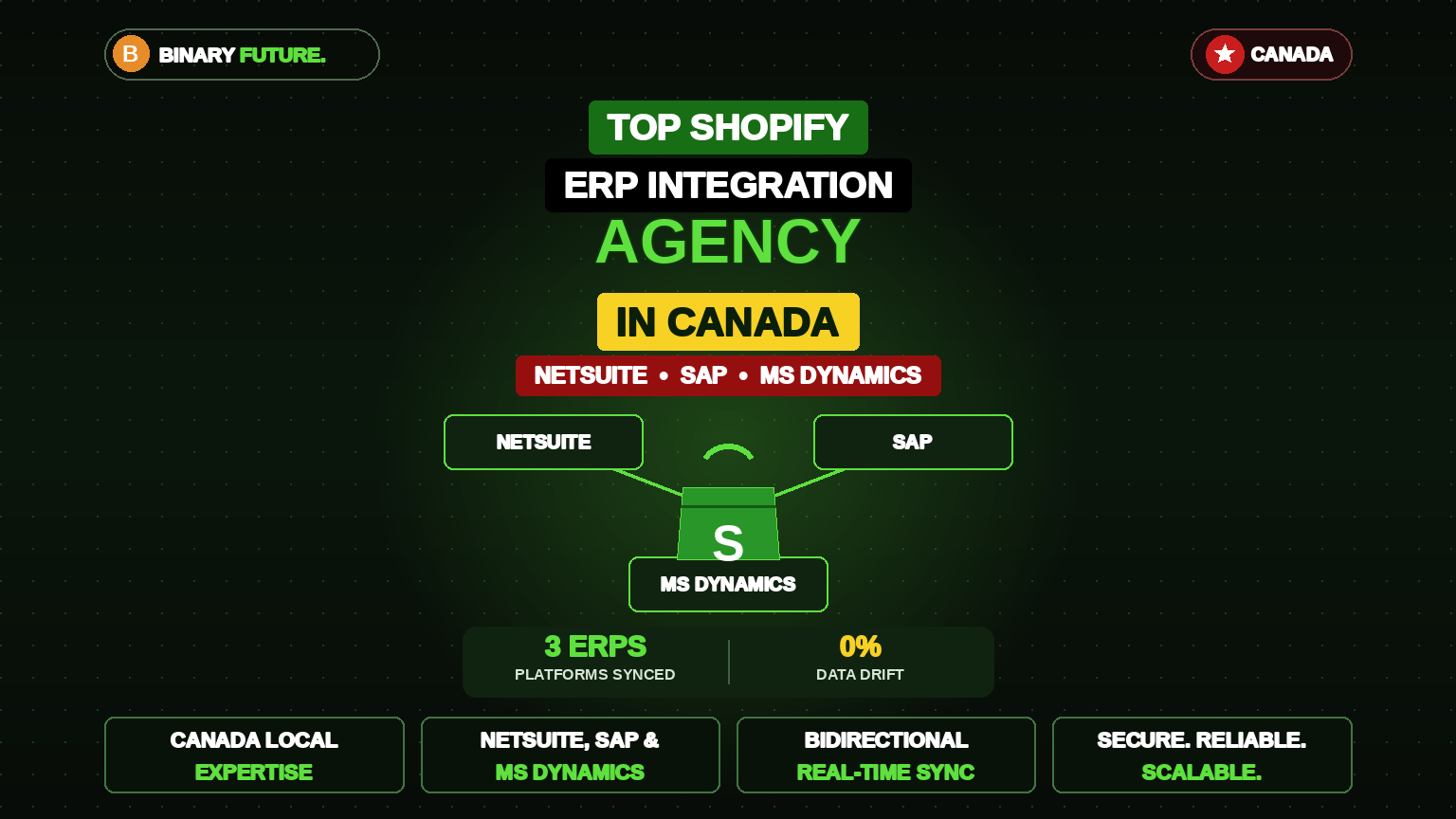
An ERP integration is not a frontend job. Choosing a top Shopify ERP integration agency in Canada means finding a team that can keep orders, inventory, pricing, and customers in sync across Shopify and NetSuite, SAP, or Microsoft Dynamics, without the silent data drift that breaks fulfillment. This guide explains why frontend vendors fail at this, the criteria that separate a real integration partner, and the red flags to avoid.
A Shopify ERP integration succeeds or fails on data, not design. The right partner thinks in terms of bidirectional sync, field mapping, error handling, and middleware, not themes and storefronts. When evaluating a Shopify NetSuite, SAP, or Dynamics integration partner in Canada, look for proven ERP project history, a clear middleware approach, real error-handling and reconciliation logic, and accountability after go-live. The three red flags: no named ERP experience, no plan for sync failures, and treating the integration as a plugin install rather than an architecture.
Connecting Shopify to an enterprise ERP is one of the highest-stakes projects an ecommerce team can take on. Done right, orders, inventory, pricing, and customer records flow automatically between systems and the business scales without manual data entry. Done wrong, the two systems drift apart quietly, overselling, mispricing, and fulfillment errors appear weeks later, and the cost lands on operations and customer trust. The difference is almost never the storefront; it is the integration architecture underneath, and that is what you are really hiring for.
Why Frontend Vendors Fail at Enterprise ERP Integrations
Most Shopify agencies are excellent at the storefront: themes, conversion, design. An ERP integration is a different discipline entirely, and the skills do not transfer. A frontend vendor sees the integration as a connector to install; an integration partner sees a distributed-systems problem to architect.
The failure points are predictable. A vendor wires a one-directional feed and calls it done, but enterprise ERP needs bidirectional sync, inventory and fulfillment flow back from the ERP while orders flow to it. A vendor maps the obvious fields and misses the edge cases, tax codes, units of measure, multi-warehouse stock, B2B pricing tiers, where the real complexity lives. And a vendor has no answer for what happens when a sync fails at 2 a.m., no retry logic, no reconciliation, no alerting. In an ERP integration, the error handling is the product. A team that has not built it before will not know what they are missing until it breaks in production.
Critical Evaluation Criteria for an ERP Integration Partner
Use the criteria below to separate a genuine integration partner from a frontend vendor taking on work outside its depth. Ask for evidence on each, not assurances.
| Criterion | Frontend vendor | ERP integration partner |
| ERP track record | General Shopify portfolio | Named NetSuite, SAP, or Dynamics projects you can verify |
| Sync direction | One-way feed | Bidirectional sync of orders, inventory, pricing, customers |
| Middleware approach | Single off-the-shelf connector | Right tool per case: iPaaS, custom middleware, or native API |
| Error handling | Not discussed | Retry logic, reconciliation, alerting, and audit logs |
| Field mapping | Obvious fields only | Edge cases: tax, UoM, multi-warehouse, B2B tiers |
| Post-launch | Exits at delivery | Monitors sync health and owns reconciliation |
If a prospective agency cannot speak concretely to the right-hand column, especially error handling and bidirectional sync, you are likely looking at a frontend team that will learn enterprise integration on your project and your budget.
3 Red Flags When Hiring a Canadian Shopify Integration Team
Red flag 1: No named ERP experience
“We can integrate any system” is not the same as “we have shipped NetSuite” or “we have shipped SAP.” Each ERP has its own data model, API quirks, and failure modes; experience does not transfer cleanly between them. Ask for specific, verifiable projects on your ERP. A partner names them readily. A vendor speaks in generalities, which is the answer itself.
Red flag 2: No plan for sync failures
Ask one question: what happens when a sync fails overnight? A real integration partner has an immediate, detailed answer, retry queues, reconciliation jobs, alerting, audit logs. A frontend vendor pauses, because they have not had to think about it. In an enterprise integration, failures are not an edge case; they are a certainty, and the partner’s entire value is in handling them gracefully.
Red flag 3: Treating integration as a plugin install
If the proposed solution is “we will install this connector app,” be cautious. Off-the-shelf connectors are fine for simple cases, but enterprise ERP integration usually needs middleware and custom mapping to handle your specific business logic. A partner evaluates whether an iPaaS, custom middleware, or a native API build fits your case. A vendor reaches for the one tool it knows, regardless of fit.
Seamless Technical Sync with Binary Future
Binary Future is a Toronto-based Shopify Plus Partner whose core work is exactly this: keeping Shopify and enterprise ERPs in reliable, bidirectional sync. We approach integration as an architecture problem, not a plugin install.
- Named ERP experience. Hands-on delivery across NetSuite, SAP, and Microsoft Dynamics, with the data-model and API specifics each one demands.
- Bidirectional by default. Orders, inventory, pricing, and customer records flow both ways, with field mapping that covers the edge cases generalists miss.
- Error handling as a deliverable. Retry logic, reconciliation, alerting, and audit logs are built in, so a failed sync is caught and corrected, not discovered weeks later.
- Right middleware for the case. We choose between iPaaS, custom middleware, and native API builds based on your systems and volume, not a single preferred tool.
See our Shopify Plus development and B2B Shopify development for how we handle enterprise integration work.
Planning a Shopify ERP integration? Get a free 30-minute integration scoping session. We will map your systems, the entities that need to sync, and the failure modes to plan for, and show you what reliable, bidirectional integration looks like for NetSuite, SAP, or Dynamics.