Building a successful Shopify business is less about luck and more about doing a short list of things well: research, branding, a fast store, trust, smart pricing, and relentless optimization. The average Shopify store converts at roughly 1.4 to 1.8%, while the top 10% reach 4.7% or higher. The gap is not luck; it is the ten steps below, executed in order.
Updated: July 14, 2026. Author: Mike Bashkatov, Senior Shopify Plus Architect at Binary Future, Shopify Plus Partner. 12 years launching, scaling, and optimizing Shopify stores. LinkedIn
To build a profitable Shopify business in 2026, work the funnel in order: research your market, define a brand, set up a fast mobile-first store, build trust with reviews, price for margin, win organic and AI search, use social and influencers, automate with apps, support customers well, and track conversion, AOV, and lifetime value. Most stores convert around 1.4 to 1.8%; the top 10% hit 4.7%-plus. Retention is the quiet multiplier: returning customers convert at 4.5 to 6% and spend 67% more than new ones.
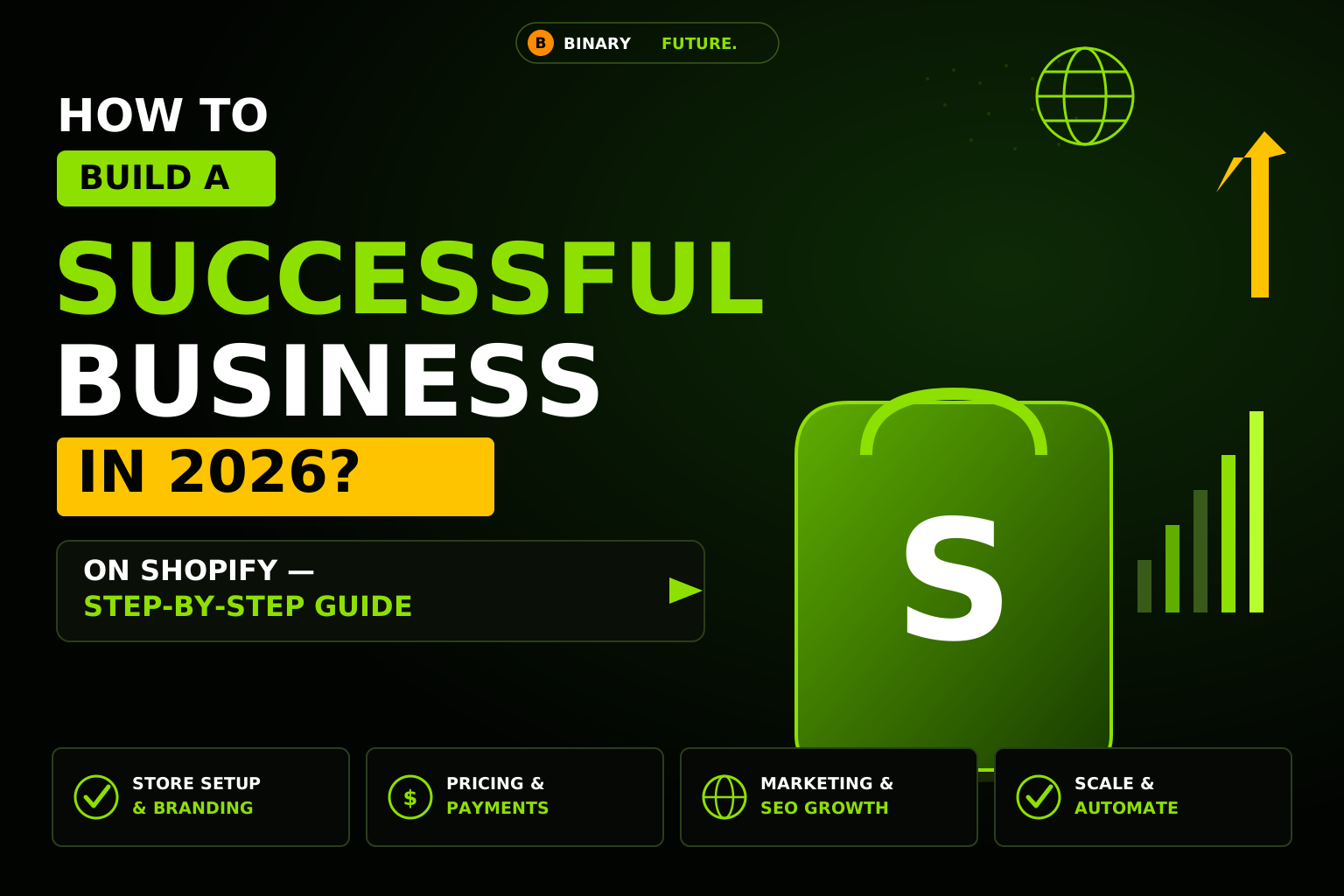
How to build a successful Shopify business is one of the most common questions entrepreneurs ask, and the honest answer is that the platform is rarely the limit. Shopify powers millions of stores and handles everything from themes to secure payments and enterprise scale, so what separates a profitable store from a stalled one is strategy and execution. This guide walks through ten steps, refreshed with 2026 data, that move a store from launch to sustainable profit.
Why Shopify Is the Go-To Platform for eCommerce Success
Shopify stays the default choice because it is easy to start, scales without a replatform, and carries the same infrastructure for a first-time founder and an enterprise brand. With over 4.8 million active stores and $235 billion-plus in annual GMV, it is also a proven commercial environment, not an experiment.
Key advantages:
- Customizable themes and layouts that you never outgrow.
- Secure, conversion-optimized payments including Shop Pay.
- Apps and integrations that automate operations.
- Enterprise scale through Shopify Plus when volume climbs.
Why it matters: You can start small and grow into a high-volume B2B or B2C operation on one platform, so early decisions are not throwaway work.
Step 1: Market Research to Build a Successful Shopify Business
Most stores that fail, fail before launch, on weak planning rather than a weak product. Research tells you who buys, what they will pay, and where competitors leave gaps.
Focus on:
- Target audience needs and real pain points.
- Competitor strengths and the gaps you can own.
- A pricing position that supports healthy margins.
Why it matters: With most first-time visitors converting at just 1 to 2%, you cannot afford to guess who you are selling to. Strong research is what makes every later step land.
Step 2: Define Your Target Audience and Brand Identity
In a crowded market, a clear brand is what makes a shopper choose you over a cheaper unknown. Identity is a commercial asset, not decoration.
Consider:
- Your brand story and the mission behind it.
- Detailed customer personas, not vague demographics.
- Consistent design: logo, colors, typography, and voice.
Why it matters: Branding builds the trust that lets you charge a fair price and earn repeat business, and returning customers convert at 4.5 to 6% versus 1 to 2% for first-timers.
Step 3: Store Setup That Drives Conversions
Your store’s design and speed directly decide how many visitors become buyers. Mobile is now the majority: 72% of Shopify sessions are mobile, yet mobile converts well below desktop.
Must-haves:
- A theme that reflects your brand and loads fast.
- Product pages with quality images and clear, benefit-led copy.
- Secure, versatile payment options including express checkout.
Why it matters: The mobile-desktop conversion gap is most stores’ single biggest opportunity; closing it with a faster mobile experience and Shop Pay can lift total revenue by 20 to 35%. For B2B stores, setup goes further; see our guide on the features every B2B Shopify store needs.
Step 4: Build Trust with Social Proof and Reviews
Shoppers trust other shoppers more than your copy, especially when your store is new and unknown. Social proof removes the hesitation that kills first orders.
Strategies:
- Collect and display product reviews with tools like Loox or Yotpo.
- Showcase real user-generated content.
- Place testimonials on product and checkout pages.
Why it matters: Reviews convert hesitant browsers, and trust signals near checkout lift completion. For a new brand, this is often the cheapest conversion gain available.
Step 5: Develop a Pricing Strategy for Profitability
Price too low and you erode margin; too high and you lose the sale. Pricing is a lever on profit, not just a number on a tag.
Best practices:
- Research competitor pricing as a floor and ceiling, not a script.
- Use value-based pricing where your product clearly does more.
- Protect margins that can fund growth and retention.
Why it matters: Revenue per visitor, which is conversion rate times average order value, matters more than conversion alone. A store at 1.5% with a $120 order is healthier than one at 3% with a $40 order.
Step 6: Optimize for SEO and AI Search
Search is the most cost-effective traffic you can build, and in 2026 that includes AI assistants, not just Google. Organic search converts at around 2.7 to 3%, well above paid social.
Focus areas:
- Keyword-rich titles, meta descriptions, and structured data.
- Faster, more usable product pages.
- A blog that targets buyer intent and earns citations in AI answers.
Why it matters: SEO and AI visibility bring buyers without paying per click, and with paid ad costs rising 15 to 20% a year, owned traffic is a growing margin advantage.
Step 7: Leverage Social Media and Influencer Marketing
Social drives the awareness that search later converts. It is the top of the funnel that fills everything below it.
Strategies:
- Encourage and reshare user-generated content.
- Partner with creators genuinely aligned with your niche.
- Run promotions, giveaways, and live shopping events.
Why it matters: Social expands reach and builds community, but track revenue per visitor by source; paid social converts lowest at under 1.2%, so it works best for discovery, not closing.
Step 8: Use Shopify Apps and Integrations to Scale
You should not build everything yourself. Shopify’s ecosystem, now 8,000-plus apps, automates the work that otherwise eats your week.
Where apps help:
- A tool for email and lifecycle marketing (the highest-converting channel at 4 to 5%).
- Subscription and reorder apps for recurring revenue.
- Fulfillment and operations apps to cut manual work.
Why it matters: Automation buys back time and reduces error. The judgment call is knowing when an app is enough and when a custom build returns more, a question worth getting right before you commit.
Step 9: Provide Exceptional Customer Support
Support is part of the product, because the cheapest revenue you will ever earn is a second order from an existing customer.
Tactics:
- Live chat for instant answers.
- An FAQ or help center for self-service.
- Regular feedback collection to fix what frustrates buyers.
Why it matters: Acquiring a customer costs 5 to 7 times more than keeping one, and raising retention just 5% can lift profit 25 to 95%. Support is a profit lever, not a cost center.
Step 10: Track Performance with Shopify Analytics
You cannot improve what you do not measure, and at scale guesswork is expensive. Data turns optimization from opinion into decision.
Key metrics:
- Conversion rate, against your industry, not the blended average.
- Average order value, the other half of revenue per visitor.
- Customer lifetime value, the metric retention compounds.
Why it matters: The blended 1.4 to 1.8% average includes dead stores; compare to your own trend and your industry. Every 0.5% lift at real traffic is meaningful money.
Conclusion: Turn Your Shopify Store into a Profitable Business
Success on Shopify comes from structured strategy, steady optimization, and the willingness to adapt as benchmarks shift. Working these ten steps in order, from research and brand through SEO, retention, and analytics, builds a store designed to launch cleanly and scale profitably, not just go live. The numbers reward the discipline: most stores sit at 1.4 to 1.8% conversion while the top tier reaches 4.7%-plus, and retention quietly multiplies the return on everything else. For brands in wholesale or complex sales environments, working with B2B Shopify development specialists accelerates this by aligning the technical architecture with the commercial goals, rather than retrofitting it later. Every refinement compounds, moving you toward a resilient, high-performing Shopify business.