Why Upgrade to Shopify Plus in 2026?
Shopify Plus is built for brands that have outgrown the standard plan and need real scale: B2B catalogs, custom checkout, ERP and CRM integrations, and 6,000+ checkouts a minute during peak. This guide walks through the signals, the real cost, and the migration path so you can decide if Plus fits your brand right now.
Updated: June 23, 2026 | Author: Mike Bashkatov, Senior Shopify Plus Architect at Binary Future, Shopify Plus Partner. 12 years in Shopify development, B2B, headless, and replatforming.
Upgrade to Shopify Plus when you generate $1M+ annually, plan B2B or international expansion, or hit limits on automation and checkout customization. Plus starts at $2,300 a month, handles 6,000 checkouts per minute, and replaces 5-10 third-party tools you are likely paying for already. The most common mistake brands make is upgrading too early; the second most common is upgrading too late and losing peak-season sales to performance issues.
What is Shopify Plus and Who Is It For?
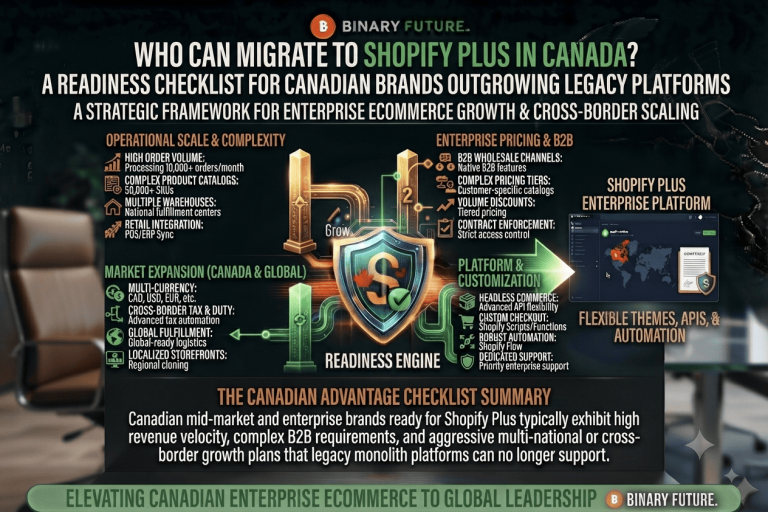
Shopify Plus is the enterprise tier of Shopify, designed for brands generating $1M+ in revenue, running multi-store or multi-region operations, or needing serious checkout and automation customization. It includes capabilities standard Shopify cannot offer: Checkout Extensibility, Shopify Functions, custom B2B catalogs, Shopify Flow automation, and access to expansion stores.
The clearest fit profiles:
- DTC brands at $1-50M annual revenue planning international or wholesale expansion.
- Wholesalers and B2B operators wanting one platform for both retail and trade buyers.
- Mid-market retailers with 500+ SKUs, complex catalog logic, or PIM/ERP integration needs.
- Brands hitting checkout customization limits on standard plans.
- Stores running flash sales, Black Friday, or product drops with high concurrent traffic.
Plus is not a “better Shopify.” It is a different operational model. Standard Shopify is configured. Plus is engineered.
What Are the Signs You Have Outgrown Standard Shopify?
Before pulling the trigger, check if these pain points hit home:
- High order volume. You are pushing thousands of orders a day and stressing over crashes during sales.
- Multiple stores. You run a US site and a Canada site, and now Europe is on the roadmap. Managing dashboards in parallel becomes a full-time job.
- B2B needs. Wholesalers are knocking but there is no smooth way to handle custom pricing, bulk orders, or net-30 payment terms.
- App stack pain. You are stacking plug-ins for checkout, promos, and reports, and the costs creep past the gain.
- Team growth. More staff means more logins, more permission management, and a need for stronger access controls.
- Integration debt. Your ERP, PIM, or CRM is held together with Zapier and goodwill.
- Performance during peaks. Page speed declines during high-traffic moments. Every dropped second of load time costs measurable revenue.
If two or more of those land, Plus deserves a serious look. If only one does, you can usually solve it on standard Shopify with the right architecture.
Where Does Shopify Plus Actually Deliver Value?
Plus stops being marketing the moment you hit four pain points: scale, checkout, B2B, and automation. Each maps to a concrete capability.
Scalability and performance
When you run a flash sale or a product drop, traffic does not creep in. It hits hard. Standard Shopify can wobble under that kind of heat. Plus is built for it.
- 6,000 checkouts per minute. Verified ceiling on Plus, well beyond what flash sales typically demand.
- Sub-second response times. Shop Pay reportedly converts close to twice as high as guest checkout, according to Shopify’s case studies.
- Mobile-first defaults. Mobile bounces if a page lags even a second; Plus themes and CDN are tuned for mobile-first delivery.
Checkout that converts
Checkout is where you win or lose. If it drags, customers bail. Plus gives you the tools to fix the friction:
- Checkout Extensibility for custom logic at every step.
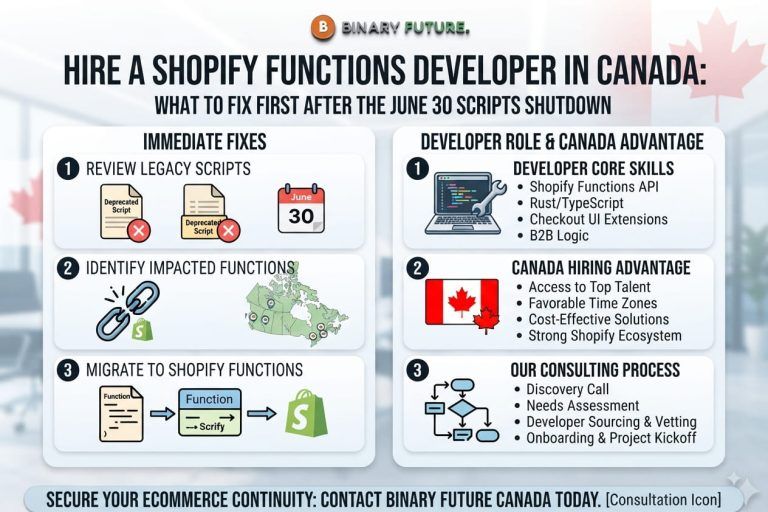
- Shopify Functions for custom discounts, payment customizations, and shipping rules.
- Post-purchase upsells with one click.
- Shop Pay for one-tap payments.
This is one of the four areas where the real ROI of Plus is measurable: 1-3% conversion lift on a $10M brand pays for the entire upgrade.
Automation that compounds
Shopify Flow turns repeating workflows into automatic ones: tag VIP customers, hold suspicious orders, sync inventory across locations, trigger email flows on cart events. Combined with Launchpad for product launches and higher API call limits, Plus lets a 5-person team operate at the volume of a 25-person one.
Automation is the only way to scale without burning out your team.
Multi-store and global expansion made easy
- Up to 9 expansion stores. Open separate stores per region or brand without a separate Plus contract for each.
- Shopify Markets. Sell in local currency and language with a unified admin.
- Organization admin. Manage staff, billing, and reporting across all brands from one console.
B2B and ERP/CRM Integration: The Underrated Upside
This is the area where Plus most consistently surprises growing brands, and where standard Shopify simply does not compete. Wholesale is hot again, and Plus bakes B2B tools right in:
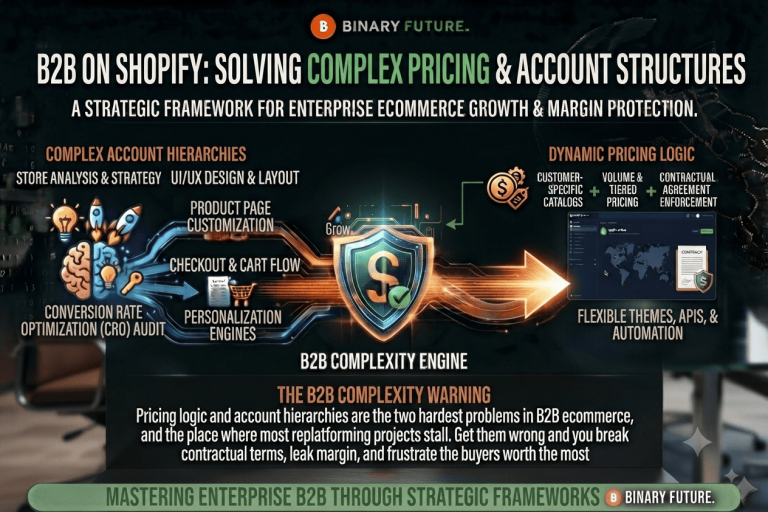
- Price lists and payment terms. Tiered pricing, net-30 / net-60 / net-90, draft orders for negotiated deals.
- Company profiles with buyer roles. A B2B customer is a company with multiple buyers, each with permissions. Plus models this natively.
- Self-serve portals for bulk buyers. Reorder, request quotes, manage POs without calling sales.
The B2B story only works in production when Plus is wired into the rest of the stack: ERP for inventory and orders, PIM for catalog, CRM for buyer relationships, accounting for invoicing.
We treat ERP and CRM integration as part of the B2B Plus build, not an afterthought. Common patterns we deploy:
- NetSuite, Microsoft Dynamics, or SAP for ERP, synced via middleware or direct API for orders, inventory, and customer master data.
- HubSpot or Salesforce as CRM, with two-way sync of B2B accounts, buyers, and order history.
- Akeneo or Plytix as PIM, feeding enriched product data into Shopify Plus.
For a deeper dive, see our Shopify Plus development services.
Custom Checkout and Automation: Where Plus Pays for Itself
Standard Shopify checkout is fast and clean but rigid. Plus removes the rigidity. This is where most of our optimization work happens after migration, and where checkout-led brands see the highest ROI.
What custom checkout on Plus actually unlocks:
- Conditional logic based on cart contents, customer segment, geography, or time. Show different shipping options to wholesale vs DTC. Hide payment methods unavailable in a region. Apply automatic gifts above a threshold.
- Custom validation to prevent orders that violate business rules, such as quantity caps for limited drops or B2B credit limits.
- Branded post-purchase upsells and cross-sells with one-click acceptance, no second checkout.
- Subscription and bundle logic native to checkout instead of bolted on.
- Integrations at the checkout layer with fraud detection, tax engines (Avalara), or loyalty programs.
Pair this with Shopify Flow, Launchpad, and webhook automations, and the checkout becomes a programmable surface, not a fixed funnel. We build custom Shopify Plus checkout flows for brands that have already hit conversion ceilings on standard checkout extensions.
The pattern we see most often: brands try every conversion app available, hit a plateau, then rebuild checkout with Plus extensibility and unlock another 5-15% in conversion.
Custom Apps and Headless Options
When off-the-shelf apps cannot model your business logic, Plus opens two paths.
Custom Shopify apps. Built on Shopify’s App Bridge and admin extension framework, custom apps live inside the Shopify admin and behave like first-party features. They are the right answer when:
- You have proprietary business logic (pricing models, custom workflows, internal data).
- Your data needs to flow between Shopify and an internal system not covered by standard apps.
- You want to consolidate a stack of 5-10 apps into one purpose-built tool.
- You need merchandising, operations, or B2B features that no public app handles cleanly.
We build custom Shopify apps end-to-end: requirements, architecture, development, app store submission if needed, ongoing maintenance.
Headless storefronts. Hydrogen and Oxygen, Shopify’s headless framework and hosting, let you decouple the storefront from the Shopify admin. The right answer when:
- You need a storefront experience standard themes cannot deliver.
- You run multiple touchpoints (web, mobile app, kiosk, marketplace) from one commerce backend.
- Performance targets are sub-1-second LCP at scale.
- You have the engineering team to maintain a custom front end.
Headless is powerful but expensive. We typically recommend it only after Plus checkout extensibility and theme customization have been exhausted. See our Shopify Headless development services for the full scope.
What Does Shopify Plus Actually Cost in 2026?
The headline price is $2,300 a month for revenue under $800,000 a month, then 0.4% of revenue up to a $40,000 monthly cap.
What is included in that price:
- The Plus features above (Checkout Extensibility, Functions, Flow, Markets, Launchpad, B2B).
- Up to 9 expansion stores at no additional Plus fee.
- Higher API rate limits (typically 4x standard).
- Dedicated Plus support.
What is not included:
- App stack ($500 to $3,000 a month for a typical Plus brand).
- Theme development or headless build ($15,000 to $150,000 one-time).
- Custom app development ($20,000 to $250,000 depending on scope).
- ERP or CRM integration ($25,000 to $200,000 depending on systems).
- Migration to Plus ($35,000 to $150,000 for mid-market, more for enterprise).
The Plus subscription is rarely the largest line item. The total cost of ownership often runs 3-5x the subscription itself.
The good news: Plus typically replaces 5-10 third-party apps you are already paying for, and the conversion lift from a Plus checkout pays for the upgrade if your annual revenue is above $5M.
For a deeper line-item breakdown, see our Shopify migration cost guide.
When Is Shopify Plus Not the Right Move Yet?
Honest answer: most brands under $1M ARR should not be on Plus.
Skip Plus if:
- Annual revenue is under $1M and growth is flat. The subscription alone eats your margin.
- You do not need B2B, automation at scale, or multi-region.
- You are still validating the product. Plus is for brands that know their unit economics.
- Your team cannot absorb a 6-12 month optimization cycle after the upgrade.
- Your operational issues are content, brand, or marketing, not platform. A platform upgrade does not fix a positioning problem.
A common mistake is upgrading because peers did. The right question is not “should we be on Plus?” It is “which Plus capabilities will move our P&L in the next 12 months?” If you cannot name three, you are early.
How Does the Upgrade or Migration to Shopify Plus Work?
Two scenarios, two different paths.
Scenario A: You are already on Shopify Standard. Upgrading to Plus is mostly a contract change. Your store, theme, products, and customers stay in place. You gain Plus features incrementally. Timeline: 2-4 weeks of optimization to actually use Plus capabilities. No migration risk.
Scenario B: You are on WooCommerce, Magento, BigCommerce, or another platform. This is a real migration project. Timeline: 6-16 weeks for mid-market, longer for enterprise. The phases:
- Audit and architecture planning. Catalog, customers, orders, integrations, SEO baseline.
- URL mapping and 301 redirect strategy. Non-negotiable for SEO continuity.
- Plus configuration: markets, B2B, expansion stores, Functions.
- Theme development or headless build.
- Data migration: products, customers, orders, content, reviews.
- ERP, CRM, PIM integration build.
- Custom checkout and app development.
- QA, staging tests, load testing.
- DNS cutover and post-launch monitoring.
We run this end-to-end as our Shopify Plus migration service, with explicit guarantees on data integrity and SEO preservation. Brands that skip the SEO migration step typically lose 30-60% of organic traffic in month one. Brands that do it right see less than 10% dip and recover within 30-60 days.
For a comprehensive checklist, see our Shopify migration checklist.
Real Brand Wins
- A fashion brand grew to nine stores worldwide with Plus.
- A beauty brand cut CAC by 25% with Shopify Audiences.
- An electronics brand reduced checkout drop-offs by 30% after a custom checkout build.
Considering Shopify Plus? Get a free 30-minute Plus readiness audit. We will review your current store, identify the top 5 Plus capabilities that will move your P&L, and give you a tailored timeline and budget.