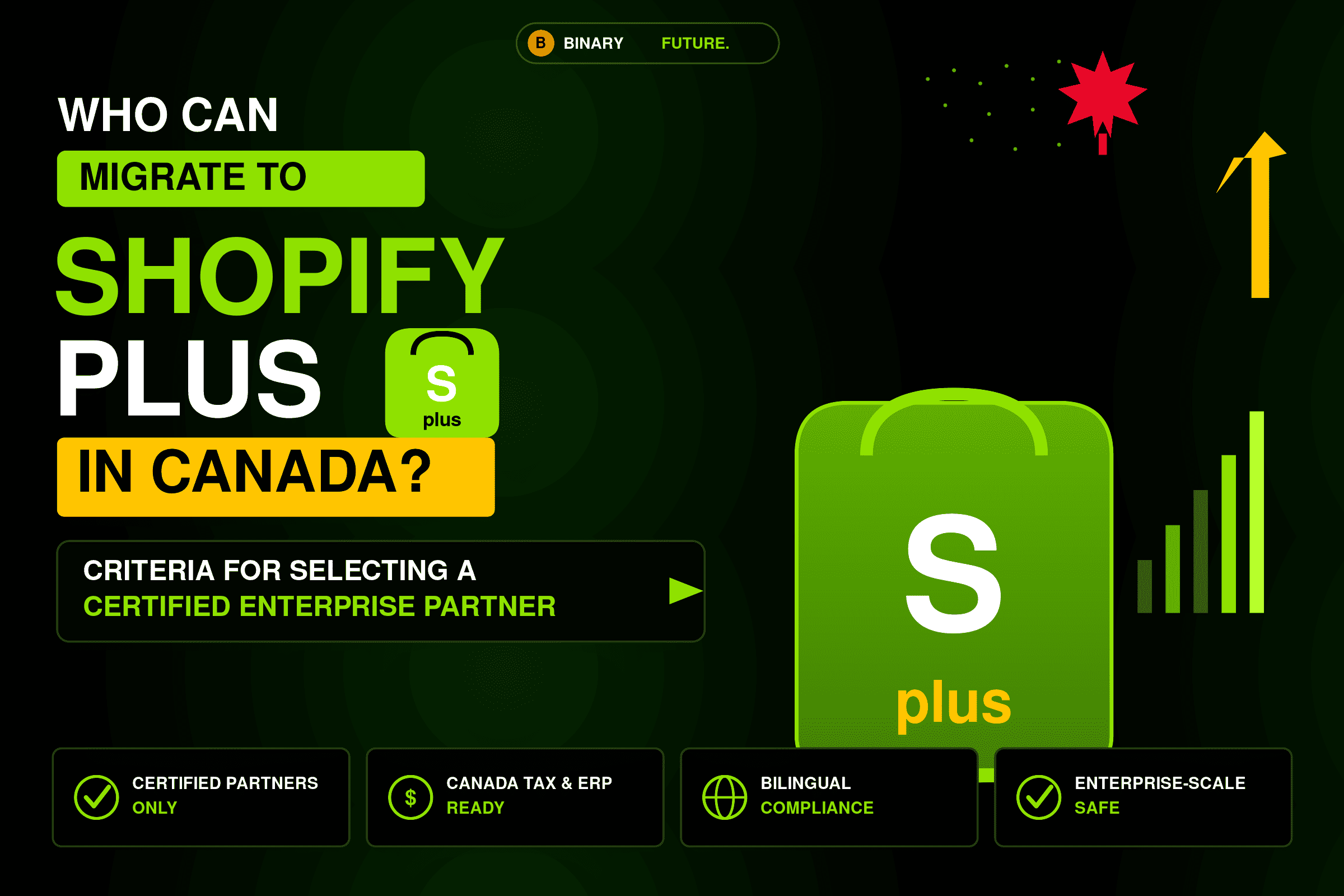
Not every developer can migrate an enterprise store to Shopify Plus, and in Canada the bar is higher because of local tax, ERP, and language requirements. This guide answers who can actually run a Shopify Plus migration in Canada and gives the criteria for selecting a certified enterprise eCommerce partner that will not break your store at scale.
Who can migrate you to Shopify Plus in Canada? Realistically, only a certified Shopify Plus Partner with enterprise experience, not a generalist freelancer or a standard theme shop. Shopify Plus is the enterprise tier, and migrations to it involve custom checkout, ERP and logistics integration, and high-volume data, work that breaks under a standard developer. In Canada, add three local must-haves: provincial tax fluency (GST, HST, PST), proven ERP sync, and Quebec Bill 96 bilingual compliance. Evaluate partners on Shopify Plus certification, enterprise track record, local Canadian competencies, and verifiable case studies, not on the lowest bid.
Why Enterprise-Level Replatforming Demands More Than a Standard Developer
Shopify Plus is the enterprise tier of Shopify, and a migration to it is not a bigger version of a small-store move. It is a different category of project. A standard developer can build a theme and import a catalog; an enterprise replatform also involves custom checkout logic via Shopify Functions, headless architecture in some cases, bidirectional ERP and WMS integration, high-volume and complex data, and zero-downtime cutover planning.
The risk of using an under-qualified developer is not a worse-looking store; it is a store that loses orders, miscalculates tax, oversells inventory, or drops search rankings at the moment it goes live. At enterprise volume, each of those failures is expensive in revenue, not just in rework. That is why the question is not just who is cheapest, but who is actually capable.
4 Core Selection Criteria for a Canadian Shopify Plus Partner
Use these four criteria to separate a true enterprise partner from a vendor learning on your project. Each is a checkpoint, not a nice-to-have.
| Criterion | What to verify | Why it matters |
| Shopify Plus certification | Listed Shopify Plus Partner status, not just a Shopify Partner | Plus Partners are vetted for enterprise capability and access |
| Enterprise track record | Delivered Plus migrations at comparable volume and complexity | Enterprise problems do not appear on small-store projects |
| Local Canadian competency | Provincial tax, ERP sync, and Quebec Bill 96 in past work | Local context decides Canadian enterprise outcomes |
| Verifiable case studies | Named, checkable results, not vague portfolio claims | Proof of capability versus marketing language |
A partner who clears all four is rare, and that is the point. The cost of the wrong partner at enterprise scale dwarfs the difference between quotes.
Local Competencies: ERP Sync, Canadian Taxes, and Multilingual Support (Quebec Bill 96)
This is where Canadian enterprise migrations are won or lost, and where global agencies most often fall short. Three local competencies are non-negotiable.
ERP and logistics integration
An enterprise store runs on its back office. The partner must demonstrate bidirectional integration between Shopify and your ERP (NetSuite, SAP, Microsoft Dynamics), WMS, and Canadian 3PL and carriers, orders out, inventory and fulfillment back, with real error handling. This is the core of the project, not a post-launch add-on.
Canadian tax fluency
There is no single Canadian sales tax. The partner must configure the 5% federal GST, HST of 13 to 15% in harmonized provinces, separate PST in BC, Manitoba, and Saskatchewan, and Quebec’s QST, with tax following the customer’s destination. Misconfigured tax at enterprise volume is a compliance and accounting problem, not a cosmetic one.
Bilingual and Bill 96 compliance
Selling to Quebec means complying with Bill 96: product descriptions, checkout, support, and invoices must be available in French of equal quality to English, and the requirement reaches businesses outside Quebec that sell to its residents. A capable partner plans French coverage as a core deliverable. Confirm specifics with a Quebec-qualified advisor.
Evaluating Portfolio & Case Studies: Red Flags to Avoid During Vendor Selection
The portfolio is where claims meet evidence. Watch for these red flags.
- No named enterprise Plus projects. Vague “we work with big brands” language with nothing checkable usually means the enterprise experience is not there.
- No ERP or integration detail. If case studies do not mention which ERP, WMS, or middleware they connected, assume the back-office work was thin or outsourced.
- No Canadian context. A portfolio with no mention of provincial tax, Bill 96, or Canadian logistics signals a global generalist who will discover these mid-project.
- Plugin-install mindset. If the answer to every requirement is “there’s an app for that,” the partner is not equipped for custom enterprise engineering.
The strongest signal is the opposite of all four: specific, named, technically detailed case studies that mention the ERP, the tax setup, the volume, and the outcome.
Scale Safely: Why Enterprise Brands Choose Binary Future
Binary Future is a Toronto-based Shopify Plus Partner built for exactly this work: complex Canadian enterprise migrations where tax, ERP, and compliance decide the outcome.
- Certified Shopify Plus Partner. Enterprise-grade access and capability, not a generalist shop scaling up for one project.
- Deep ERP and logistics integration. Proven bidirectional connections to NetSuite, SAP, and Dynamics, plus Canadian WMS and 3PL, with real error handling.
- Canadian by default. Provincial tax, Quebec Bill 96, and local logistics are core scope, not afterthoughts discovered post-launch.
- SEO and data integrity guaranteed. Full 301 redirect mapping and data validation on every migration, protecting rankings and revenue through the cutover.
See our Shopify Plus development and Shopify migration services for how we run Canadian enterprise replatforms.
Frequently Asked Questions (FAQ)
Who can migrate my store to Shopify Plus in Canada?
Realistically, a certified Shopify Plus Partner with enterprise experience, not a generalist freelancer or a standard theme shop. Shopify Plus migrations involve custom checkout, ERP and logistics integration, and high-volume data that break under an under-qualified developer. In Canada, the partner also needs provincial tax fluency, proven ERP sync, and Quebec Bill 96 compliance.
What is a Shopify Plus Partner, and why does it matter?
A Shopify Plus Partner is an agency vetted by Shopify for enterprise-grade capability and granted the access that Plus projects require, a higher bar than a standard Shopify Partner. For an enterprise migration, that certification is a baseline filter: it signals the partner has delivered at the complexity Plus demands.
What are the core criteria for choosing a Canadian Shopify Plus partner?
Four: Shopify Plus certification, an enterprise track record at comparable volume and complexity, local Canadian competency (provincial tax, ERP sync, Quebec Bill 96), and verifiable, named case studies. A partner who clears all four is rare, but the cost of the wrong choice at enterprise scale far exceeds any difference in quotes.
Why does a Canadian Shopify Plus migration need local expertise?
Because the local context decides the outcome. Provincial tax (GST, HST, PST, plus Quebec’s QST), integration with Canadian ERP and logistics, and Bill 96 bilingual compliance are all areas a global generalist tends to underestimate. A local partner scopes them from the start instead of discovering them in production.
What red flags should I watch for when evaluating a partner?
No named enterprise Plus projects, no detail on which ERP or middleware they integrated, no Canadian tax or Bill 96 context, and a “there’s an app for that” answer to every custom requirement. The strongest positive signal is the opposite: specific, technically detailed case studies naming the ERP, tax setup, volume, and outcome.
Can a regular Shopify developer handle a Plus migration?
Usually not safely. A standard developer can build a theme and import a catalog, but enterprise Plus work, custom checkout via Functions, bidirectional ERP integration, high-volume data, zero-downtime cutover, exceeds that skill set. At enterprise volume, the failures (lost orders, tax errors, overselling) are expensive in revenue, not just rework.
Does my brand qualify for Shopify Plus?
Shopify Plus is aimed at high-volume and enterprise merchants, brands with significant GMV, complex catalogs, B2B or multi-store needs, or custom checkout and integration requirements. If your store has outgrown standard Shopify on volume, customization, or back-office complexity, you likely qualify; a certified partner can confirm the fit and scope the move.
Read also
About the author
Mike Bashkatov is Senior Shopify Plus Architect at Binary Future, a Shopify Plus Partner agency in Toronto. Over 12 years he has led enterprise replatforms onto Shopify Plus for Canadian brands, with deep work in ERP and logistics integration, provincial tax, and bilingual compliance. Find him on LinkedIn.
Evaluating partners for an enterprise migration? Get a free 30-minute scoping session. We will assess your Shopify Plus readiness, map the ERP, tax, and Bill 96 requirements, and show you exactly what an enterprise-grade migration involves.